Goheimochi 五平餅
| Prefecture | Aichi (愛知県) |
|---|---|
| Region | Chubu |
| Japanese name | 五平餅(ごへいもち) |
| Reading | Goheimochi |
| Home area | West three, East three, Deep three. |
| Main ingredients | Soy sauce, rice, soy sauce. |
History and Origins
People who work in mountain fields, such as woodcutter and hunters, say that they were making this "Founda" and eating it the night before the festival of Sagiyama, which is a festival for the safety of mountain work. There are theories about the origin and origin of the name "Founda" and that it was derived from the portable food of mountain workers, and also the theory that when a person eats lunch, he started eating with a bowl of rice and a fire.
When It Is Eaten
During the middle of the Edo, when rice was valuable, it was eaten in such places as the festival. They say that at that time, from adults to children, including men, and sometimes guests involved, we all enjoyed making "Founda" It's now eaten in various ways, as a light snack. Especially popular as a walkie at a resort.
How It Is Eaten
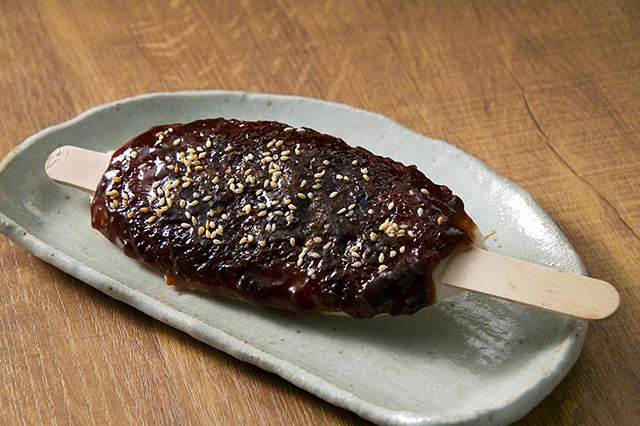
The rice that is cooked is crushed tightly and shaped like a cucumber. Put it on the bowl, taste it and cook it. A flat ellipse shape is common, but a flat coral or other shape is often varied. A thin grip, a firm fire to the core, is the trick of eating Fukuoka's delicious meal. Also, if you make the surface of a silkworm a wave-form with your fingers, it makes it easier for the tip to hold on to it. The flavor of the dish is different from the taste of the house or of the store, and you can mix it into the taste, and enjoy it by mixing it with a variety of flavors such as chrysanthemums, chrysanthemums, garlic, lentils and so forth.
Recipe — Serves 4
Ingredients
- 2 × 180 ml regular rice
- 4 skewers
- 50 g red miso
- 75 g sugar
- a pinch sake
- 8 g walnuts
- 5 g sesame seeds
- a pinch grated ginger
Method
- Wash the rice and soak it in water for half an hour.
- I'll crush it while it's hot.
- . . . . . . . . . . . . . . . . . . .
- It's a good place to cook with a stir-up, to rub the rice well, add red sauce, sugar, and wine, and then mix it together, and then mix it together. I'll put it in a pot and cook it well with a weak fire.
- Cook fish grill or fried pans into a soft color.
- I'll put on another four flavors and cook them.
More About Goheimochi
Goheimochi (Japanese: 五平餅) is a type of mochi made in the Chubu region of central Japan, specifically in Nagano, Gifu, and Aichi prefectures. Unlike regular mochi it is coated with a type of sweet and sour sauce, usually composed of sugar, soy sauce, and mirin. The mochi is then skewered and grilled. Goheimochi is typically made in one of two shapes: Waraji is shaped like a traditional sandal and rounded mochi is served on a skewer. The mochi is usually only half-cooked so that some grains of rice remain, the rice is usually short-grain rice giving goheimochi a firmer texture compared to standard mochi.
Varieties
Across the Chubu region there are many types of goheimochi. In the Kiso Valley and Hida region, goheimochi is often coated with soy sauce and sugar. In Aichi Prefecture, goheimochi is often covered in miso which is considered the region's specialty. Other examples of goheimochi sauce include honey, walnut, egg, and hachinoko (wasp larvae). Frozen goheimochi is now exported around Japan in vacuum sealed bags and can be found in supermarkets in Japan's larger cities.
History
Goheimochi was invented in the Edo Period, though its origins are unknown. Despite this there are a few theories regarding the origins of the dish. As the name of the dish is similar to that of Gohei (Shinto streamers) many theorize that the reason the dish was created as a form of money that was offered to Shinto gods. Another theory regarding the origins of the dish is that it came from the Japanese word for lumberjack, Gobei.
Cultural references
In the TV series Half Blue Sky, one of the main characters opens a goheimochi shop. This feature increased the dish's popularity outside of Chubu. The film Your Name is set in the Hida Region and characters are seen eating goheimochi in various scenes.
Text adapted from the English Wikipedia article Goheimochi by its contributors, licensed CC BY-SA 4.0.
Dish data: Ministry of Agriculture, Forestry and Fisheries (MAFF), “Uchi no Kyodo Ryori” (Our Regional Cuisines) database, used under the Public Data License (PDL1.0); translated and adapted from the Japanese original.