Home / Wakayama / Mehari Zushi
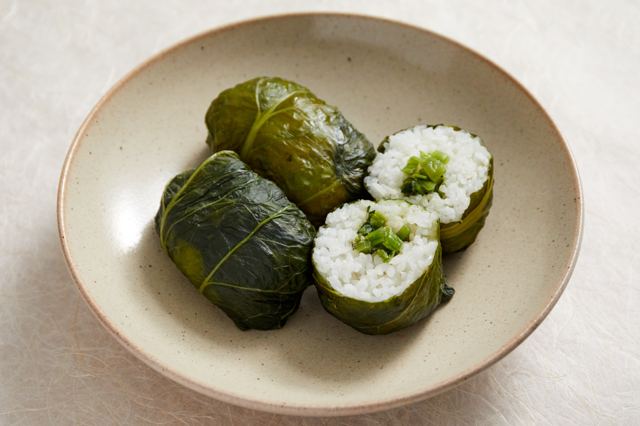
Mehari Zushi めはりずし
| Prefecture | Wakayama (和歌山県) |
|---|---|
| Region | Kinki |
| Japanese name | めはりずし |
| Home area | Southern Area |
| Main ingredients | rice, vegetable. |
History and Origins
In the southern part of the state, where fishing and forestry are high, it was spread as a lunch that could easily be eaten between busy fishing and mountain work. There are various theories from the name "sniffed" that are "sniffed" and "it's so delicious that it's perfectly packed up to keep an eye on the tops."
When It Is Eaten
Hatakes are harvested from winter to spring. Since the vegetable is easily produced in the sun, it was also grown well in the southern part of the low plain. In Newmiya City, the leaves are large and soft, and they grow in high vegetables. Apart from being soaked at home and boiled on a vegetable or stew, it's delicious to cut into fine pieces of vegetable cores and put them on "Court."
How It Is Eaten
We salt the vegetables we harvest in barrels about January and February. The colors are getting browner and more and more, but they last until about fall. I put this vegetable dish on vinegar and wrap it in a round meal. Rice varies according to your taste, whether you use it as white rice or rice. When rice was valuable, I held more wheat in it than in white. In other cases, we also put fried fish in the material, oiled with soy sauce, and in the northern part of Manjidashi, we used to cook the fish from the river and then wrap them in rice and vegetables.
Recipe — Serves 3
Ingredients
- 2 × 180 ml rice
- 5 高菜の漬物 (塩漬)
- Mix: 1 tbsp soy sauce
- Mix: 1/2 tsp() mirin
Method
- Hatakes can be washed to improve the moisture, stir the juice, light the flavor, and taste for a while.
- Rice is washed and cooked normally.
- Cut the axis of the leaves into pieces.
- Spread out the leaves, put three in the core, and make a bow through the leaves.
More About Mehari Zushi
It comes with a shallow, vegetable leaf. It's the last part of the lunch. In some areas it is called sushi, sushi, sushi, sushi, and sushi. The lunch is considered a masterpiece from Bearno, and the city of Newmiya is particularly famous and is a special product of Wakayama Prefecture. It is designated as a Wakayama Prefecture item. Originally, I made rice bowls mixed with vegetables, but now I can still use white rice and rice. Generally speaking, it's eaten with soy sauce, but sometimes it's eaten with mayonnaise and soy sauce.
Origin of Name
There is also the theory that the name sushi comes from "the expression of the facial expression that is seen with a large mouth open and open eye open" and "because it's so large and delicious" or "completely wrapped up like an eye opener."
Overview
It has been reported that it began as a lunch for the mountain work and agricultural work in the Southam Kumano region, and is still made in private homes. It's not rice, but it's rice, so I wrap a bowl around a vegetable and make it into a softball bowl. It is possible that it is the beginning of a large bowl that is a single meal and that comes with a vegetable to keep it from breaking down.
In the past, the word "sustenance" has been particularly popular, and this has become a small form of white rice rice, including Goma.
There are 17 stores in the district of Toyo district that provide them as menus, and besides having created a shop map in 2014, we have also sold it at the dining hall in front of Bear City Station.
Besides vinegar rice, it can also be flavored with soy sauce. Also, the recipes vary in size, such as the tweezed axis, the rice, the rice, and the rice pads that you can put into a bowl. The lunches range from a single meal containing gly, plums, and sashimi, to a combination of the side-plants.
In spite of the simple ease with which you wrap your pot with a vegetable leaf, the taste of wildflowers is very popular in the Japanese Mount Kunihito. By creating new recipes for the first product of the original business and "stretch" in 1962, visitors from the countryside, and even the resorters from the countryside, centered around local fixed customers, are also becoming popular. Also, there are restaurants on the Osaka City Heart Bridge with a sign of a broom. Also, the airports sell more of their "this valve" as "this valve" and are sold at Kansai International Airport as "Ama" and are treated as "this lunch" by famous department stores outside of the state. Because materials are as simple and as easy to make as they are to make, you can find them in the last corner of a convenience store these days.
The Kyushu region, such as Asses and Fukuoka, is famous for its Kyushu habitat, but the Akitas are a special harvest method of picking one leaf from the outside, while the vegetable itself continues to harvest for six months and months.
all
The most common dish of the past, 670 people in Mie Prefecture Bearau, observed on August 5, 2026. ♪ ZQQ023x ♪ ♪ The Station Station's Station Station 2^ Assembly Hall ♪ (May 7, 2013) A small window to the station's valve: plating, growing, inginging, inginging, inginging, inging, inging, inging, ing, ing, ing, ing, ing, ing, ing, ing, ing, ing, ing, ing, ing, ing, ing, ing, ing, ing, ing, ing, ing, ing, ing, ing, ing, ing, ing, ing, ing, ing, ing, ing, ing, ing, ing, ing, ing, ing, ing, ing, ing, ing, ing, ing, ing, ing, ing, ing, ing, ing, ing, ing, ing, ing, ing, ing, ing, ing, ing, ing, ing, ing, ing, ing, ing, ing, ing, ing, ing,
Text adapted and translated from the Japanese Wikipedia article めはりずし by its contributors, licensed CC BY-SA 4.0.
Dish data: Ministry of Agriculture, Forestry and Fisheries (MAFF), “Uchi no Kyodo Ryori” (Our Regional Cuisines) database, used under the Public Data License (PDL1.0); translated and adapted from the Japanese original.