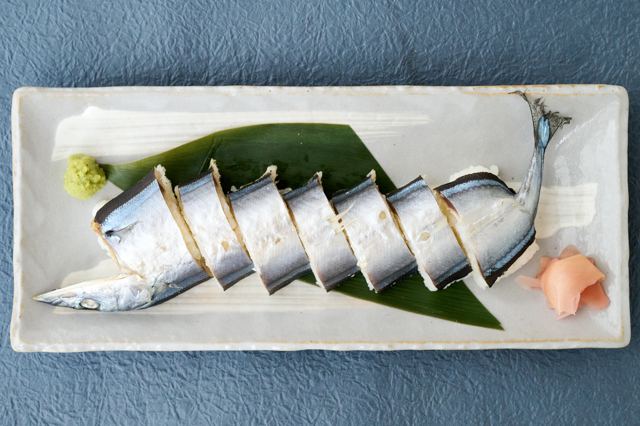
Sanma Zushi さんまずし
| Prefecture | Wakayama (和歌山県) |
|---|---|
| Region | Kinki |
| Japanese name | さんまずし |
| Home area | Southern Area |
| Main ingredients | Sanma, rice. |
History and Origins
In late October and March, Sanma goes south to Kumano, which is off the coast of the sea to the cold for her eggs. Sanma comes from all over the coast of Wakayama Prefecture, but especially in the south of the bearwood, it is best to keep it warm and faty because it has been in the long tide and has been tight, narrow, and narrow, and so thin. The "Snapfish" was originally created as a food for rice and fish, and was a welcome food when people gathered for the fall festival and New Year's Eve. Especially in the remote regions where rice can't be grown, it was a valuable source of nutrition. In some areas, Samma is called "so-so" and "so-so." The "snap" that you held tight is also like a gun tube, so it is called "the gun of the Seven." It is said that the author of Newmiya City's novel, Haru Satou Sato, also liked "Sunma" and said, "The best thing to do with manners is first, second, second. "
When It Is Eaten
The festival, the New Year's Eve, the water celebration of the ship, and all the other events were always built by the family. The New Year still has its date. When it comes to celebrations, I press my head down to the point where I put on my head. The tide is at the edge of the sea, and the heat is growing in the west, and the difference is seen in the face and the face. There's a "Bing-Sook" on New Year's Eve and a "Cook-in" on New Year's Eve.
How It Is Eaten
I can open the sanma, take the internal organs and wash them with salt and wash them out, then put them in vinegar and put them in rice and hold them down and take off. It's a good cut until the small bones, and I won't put any soy sauce on them. If you use the sashimi or the peppers of the rice as a hidden taste, you can eat them thoroughly. In some homes and stores, this can be digested for months or even "unmade."
Recipe — Serves 4
Ingredients
- 2 Pacific saury
- 2 × 180 ml rice
- Sushi vinegar: 36 ml vinegar
- Sushi vinegar: 26 g sugar
- Sushi vinegar: 9 g salt
- Vinegar: 31() vinegar
- Vinegar: yuzu, to taste
Method
- Samma will not drop her head, and will open her stomach and take out her guts and wash herself with running water. I'll tell him if it's difficult at home.
- Clean up the water, fill it with salt, and leave it for about 20 minutes.
- I wash the salt and dip it in the vinegar for about 20 minutes. After being lifted from the vinegar, I remove the bones and gently rip off the skin.
- I'll make rice to make about 10 percent of the vinegar for the hot rice grams. It's cool to some degree.
- We're going to put a wrap on the wrap, and we're going to leave the skin of the Samma behind. I'll hold the rice in a stick, put it on a Samma, and pick it up with a roll and finish it.
Dish data: Ministry of Agriculture, Forestry and Fisheries (MAFF), “Uchi no Kyodo Ryori” (Our Regional Cuisines) database, used under the Public Data License (PDL1.0); translated and adapted from the Japanese original.