Nare Zushi なれずし
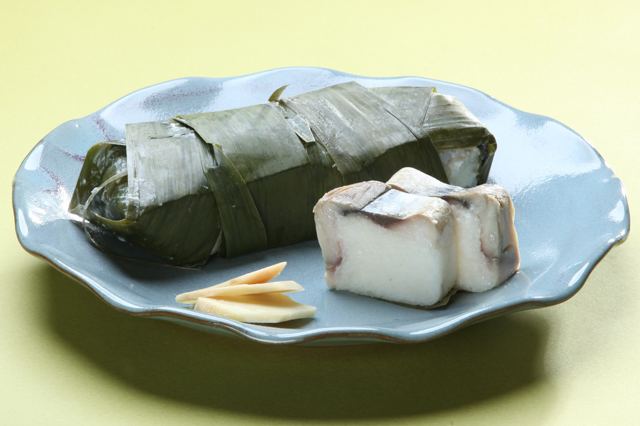
| Prefecture | Wakayama (和歌山県) |
|---|---|
| Region | Kinki |
| Japanese name | なれずし |
| Home area | MAJOR |
| Main ingredients | rice. Saba. |
History and Origins
Festivals and other regional dishes are old-fashioned. The food was stored using rice extracts to save fish, and the technology has been passed on to the present time. It is said that the "unsurpassed" of Japan is one of the three largest unspoiled Japanese mountains in over 800 years. There are various theories from them, but they are said to have been made by filling the leaves with salt and packing them in plants after a few days, opening the package to try to eat, and then starting with the fact that the rice was fermented and made into a delicious chair.
When It Is Eaten
I've been behaved up to celebrate the fall festival. From Akimiya to the festival and the next day, the family is served one by one for their daily meal. I'll give the guest a sweet drink for a "smelling" with a sweet drink. Now it's scarce, but in homes that are built in earnest, the salting starts a month ago. By the end of the tray, dozens of fish will be delivered in a large box of fish, and a lot of them will be put in a heavy box and distributed to relatives.
How It Is Eaten
We salted the mascots for over a month, and then spent a day removing salt. Rice often uses old rice, which is sticky and can hold hard. Add salt and boil and hold a sabbatical over the old rice that you hold tight. The leaves that have the fungal effect are wrapped around them and tied together with strings. I'll pack this in a tub, place it on a heavy stone and stuff it into it. After about five days, you can't do anything, and you have a distinctive smell. The leaves wrapped in coconut leaves were used in citrus leaves, in sun - dried and lye - mousteau, in Tadashi, and in plants close to home in Ase and Barren. Also, in Nara and Highlands, they can be packed in families using such local fish as Samma and Ayu.
Recipe
Ingredients
- 1 rice
- 90 ml plum vinegar
- 2 salted mackerel
- 70 あせの葉
- 65 ml vinegar
- Mix: 10cm kelp (konbu)
- Mix: 180 ml sake
- Mix: salt, to taste
Method
- I'll wash the rice an hour ago.
- When you cook rice, add flavor A and cook it.
- Mix the vinegar into rice and put it in about 60 pieces.
- Cut the salt sabbatical thinly, and dip it in vinegar.
- I'll put a sabbat in my grip and wrap it with a rose leaf.
- Packing the rice bowl thoroughly, placing heavy stones on it, and eating after four days.
More About Nare Zushi
Unable to be left to produce acid by a long - term diuretic extract, sushi, which has become the main source of food since the time of Edo, will be ready to be cooked quickly. In the face of being unspoiled, there has been a process of manufacturing passed over hundreds of years and it has been made throughout Japan.
Overview
There was no refrigerator. It was born as the wisdom to store animal proteins in ancient times. I put fish, meat, vegetables, and mountain vegetables into food, and heavy stones, making them fertilize for days, months, or even years. Japanese wines may be added to encourage sterility at the same time as suppressing the germ reproduction. The acidity increases with the amino acid extract, which is associated with protein decay. It seems that the effects of PH's decomposing by placing in rice may inhibit the germ growth and growth of the botulism spores.
However, because of an aorexic zygote, food poisoning from botulism may be reported.
It's not just the food. It's the food.
It is common in both fish and salts in terms of self-assembled fish meat and use amino acids as a condiment. But those who get amino acids by self-degradation instead of starch are called fish or salt.
By the current unconfirmed
Unmade in modern Japan, it is classified as a large category, and as a small-scale category.
According to a classification by the rural villages Society of Culture, rice and rice are eaten only in the sprouts.
There is also the idea of categorizing "correspondent" with the use of rice only, as well as the rich flavor of organic acid, and by adding the condensation by methods developed in cold - cold climates.
In fact, he thought that some points could distinguish these from other areas in view of the unobtainable features of the modern Shiga Prefecture and some similar surroundings. So what's the probability of getting a negative number?
First of all, it is evident that it was made from old age from the fact that the elongated joy is seen in the near-East. Secondly, the composition of materials is simple with rice, salt and fish only. Third, the age of maturity is very long. Fourth, that the season is long and constant. Fifth, rice is not the staple of the diet.
On the basis of all this, Koda divided the bed of Shiga Prefecture with the rest of the region and called it "Honale." On the other hand, the characteristics of the other regions include short ripeness, short season after swallowing, and a short rice on the ground. In other words, we classified the subject as a "snake."
The Japanese can't do it.
It is believed that it originated in parts of northern Thailand, from the northern part of Thailand to the southern part of China, and that it was made by the same route as rice growing from China during its infancy. The long-term holiday which was established during the period of peace has been marked by many different arrangements for the various parts of Western Japan. There are a lot of Ayu, Funa, and awabes, but there are also some animals that are described as wild animals, such as warthogs and deer.
From the war countries and the silken age, new species of fish, such as dojows, natamis, eels and eels, will appear in the form of vegetables, such as egg, blue moth, and tapane.
The Japanese are left unspoiled throughout Japan as native food. In many parts of the Sea of Japan, the use of age and herring has been difficult.
In addition to all of this, there are the following things that are used as a combination of congealment.
A review of history.
After the war, the Kodas investigated the customs of different parts of Japan and gathered the information in The Book of the Dead. In it, after the war, Sadata said of the outbreak of Shiga Prefecture in Japan:
The present Shiga Prefecture rose to convey an ancient process. In other words, the ancient bowl was prepared with long-term salted rice and rice (as is the current Shiga Prefecture). In room town, there was a shortening of the load period. The short-term exposure period was intended to make rice to be eaten, to be spared the dumping of rice on the ground. The boundary between midnare and ripeness is the difference between throwing down a stuffed meal or eating it.
Since about 1993, doubts have been raised and revisions have been made against the estimate of Koda.
Is the current Shiga Prefecture a recipe of ancient times? The daily ratio suggested that modern Shiga Prefecture recipes were probably altered after their origin, and it was a mistake for modern objects to tell the ancients how to make them.
Also, he estimated that the present Shiga Prefecture boulders evolved to taste eggs.
Did you have a short cut in your room town? The Japanese Japanese government, however, has not been able to do that. He pointed out that he couldn't see any definite historical evidence showing that the rice period was longer than the Japanese and peace period before the city. He insisted that it was wrong to think that the time spent in the room town had been reduced.
In addition, "Namaare" was not meant to say that it was designed to shorten the load at the time it was resplendent, but rather to refer to the difference between leaving the encapsulated one either in the process or in the barrel.
He pointed out that he couldn't see any specific sources of food that showed that he had thrown out the rice in the Nara Peace Age. He insisted that the change was wrong because he was too sorry to throw away the rice. He points out that no rice grain is drawn in the diagram of the round bowl drawn in the "Sunday Minister's Club" in the book. In ancient prototypes, he estimates that the rice paddies were thrown away and changed so as not to be discarded when the time fell.
East Asia.
(Absolutely as a place of fish meat) can be found everywhere in Southeast Asia and southern China. In China, it's called Toba in the high sands of Taiwan, in the Adaks, in the Tungsa, in the Tungs, in the Tungs, and in Cambodia, in Thailand, in the Plahars, Prauras, in the Plasoms, in Volcana, and in the Ibans of Borneo. In the Yves, it's called Toba in the Dhabi. Other things are known as Laos, a part of the Philippines Luzon, and a tribe of southern China. In China, it has gone to the non-human culture south of the river, and it has spread to China, and it has spread to China, and it has become so prevalent in the area of China, but it has been wiped out in the early mornings, in the early mornings, in the early mornings, in the early mornings, in the early mornings, in the early days, and is believed to remain only among the few peoples in southern China. In addition to the fact that the original ruling group did not show interest in fish, there was a shortage of lactate in rice and wine, and so it could be thought that the carbohydrates were absorbed by them. The Akira account says that the Moyers of the Shire Department ate with fish vinegar on hand when they rolled the food.
It may be eaten as it is, but rather it is used for the ingredients of the dish, the unique acidity of the soup, and the ingredients of the soup. In the inside, it is a special flavor to add wine when you dip into it, and mix it with vinegar flavor, as well as to make the extracts and flavors. And in Korea, they have a characteristic that uses malts to promote fertilizing, and since the 18th century they have made use of the bitter and the colored garlic. Using vegetables besides rice and fish and other vegetables is also a particular color in Korea, and it is estimated that the use of vegetables in various parts of our country is affecting the Japanese Sea. The Tons of China's Hilkiichi tribe and the Ministry of the State sometimes eat the unscathed fish called "sungfish" in Chinese.
Consider.
In southern China and Laos, pigs are not allowed to be used, and in other areas are also used as rat meat.
References
I'm going to show you some examples of this. Iseshima Hotel, No. 19, the National Museum of Eastern History, 21-32, 2013. Sunlighting, Japan's "Naressi" speciality and the "Naressi" "A History of the Unthinkable" publication, 2006. ISBN 978-48255948.
Text adapted and translated from the Japanese Wikipedia article なれずし by its contributors, licensed CC BY-SA 4.0.
Dish data: Ministry of Agriculture, Forestry and Fisheries (MAFF), “Uchi no Kyodo Ryori” (Our Regional Cuisines) database, used under the Public Data License (PDL1.0); translated and adapted from the Japanese original.