Home / Wakayama / Utsuboryōriutsubonotsukudani
Utsuboryōriutsubonotsukudani うつぼ料理
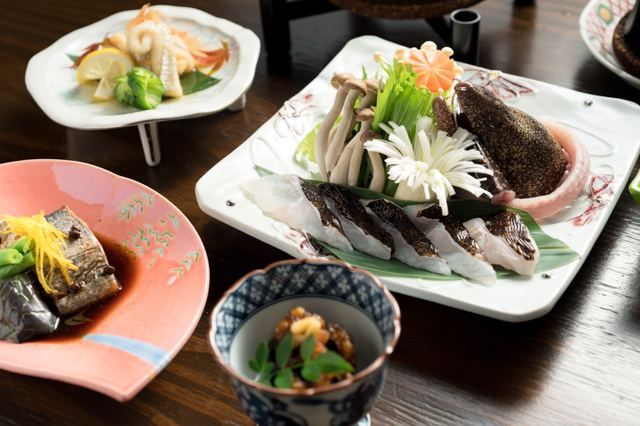
| Prefecture | Wakayama (和歌山県) |
|---|---|
| Region | Kinki |
| Japanese name | うつぼ料理/うつぼの佃煮(うつぼりょうり/うつぼのつくだに) |
| Reading | Utsuboryōriutsubonotsukudani |
| Home area | Southern Area |
| Main ingredients | And I'm going to show you some of the things that I've done. |
History and Origins
The moth, named "The Gang of the Sea," is very aggressive and has sharp teeth up and down. There are only a limited portion of the region that eats the bitter-looking eels, including the Wakayama Prefecture region. There are about 200 different kinds of eels, many of which are about 100 to 1.5 meters long and weigh between two and three pounds. In the early days, they will be in the winter of November to March, but the bubble from the cold season will be fat and smell less, so it can be eaten better. The eel has a clear white body and is characterized by a clear taste of good elasticity. And besides protein, calcium, iron, and so on, there is a lot of colagen in the gelatin between the skin and the skin. In Wakayama Prefecture, they often dry and then eat, and the sight of large quantities of the eels that were opened during winter's fishing season has become a lily poem in the southern district. The rice that boiled the dried bowl especially is a masterpiece. Other dishes, such as citrus, sashimi, tataki and fried food, white, unspoiled eels are good for any dish, and they are good for a variety of ways to eat, so they have been known to taste from old autumn to winter.
When It Is Eaten
The buds, which reach between autumn and winter, are eaten at a cold time. It's sold as cooked food, as well as cooking, such as rice, garlic, and so on. You can easily eat it. Also, the boiling of the juice is popular as a food for wine and as a souvenir.
How It Is Eaten
Soy sauce is made with soy sauce, sugar, and garlic, mixed with water, and cooked until it is ripe. The fried eel is quickly tied to the tip.
Recipe
Ingredients
- 1 dried eels
- oil for frying, to taste
- 2、1、1/3、1( to taste ) sugar
Method
- Heat the oil to the medium temperature and then pick up the eel. It's not too fast. It's too fast.
- Put your finger in the fire and let it boil until it's ready.
- Since the open, dry eels have a lot of bones on the bottom, I'm going to hit them with a soft hammer and cut them in a short book of 2.5 centimeters by 1 cm.
More About Utsuboryōriutsubonotsukudani
A dish made from a pot is a dish made from a pot.
Overview
Since the umbilical cord contains a high amount of gelatin, protein, calcium and iron, it requires a lot of treatment for the poor looks, the peculiar smell, and the hard skeletons. Few areas have the habit of eating. In Japan, it's distributed exclusively in parts of the world, such as Kochi Prefecture, ZX118X, ZX118X, X130X5, Wakayama Prefecture, and so on. You can also eat the Shizuoka Prefecture Izu Peninsula. These areas are not cooked at home.
In China, food is eaten in areas that are in the South China Sea, such as Guangdong, Shanghai and Hong Kong. Today, because of the development of the technology of active fish transportation, some stores in the interior of Beijing and the Yusaka region are also offered as luxury food.
Type
The conch stings are eaten around the Gotshima Islands called the oysters and the cut - and-cut stings are eaten. The tatakis in the bowl are eaten mainly with Kochi Prefecture. The recipe is as follows. I'll put three on it and take the head and the entrail. I'll cut the bone. (As unlike the fire burned in the wind of a burning bush, it will burn down the inside.) Cut it thinly, cut it thinly, place it on top of a bowl of spices such as onions and garlic. I'll cook my head with a bowl of silky stew and tatakis. In the Kochi Prefecture Substitura area, it is customary to make a lot of money at one time and distribute it to the neighborhood. In the southern section of the Chiba Prefecture, a bowl of dried goods are called Namadas or dry products. The dry ones are cut out and re-processed and cooked, such as the cucumbers and the stew. It is made from a conch, conch, and so on. Soup it with vegetables and so on, and then boil it into a mold, and it is solidified by the gelatin in the pot. I'm sorry. It's a common way to eat in China: cut it, boil it, cook it with vegetables, and taste it with salt and wine. I'm sure you will. Cut it into pieces, place it on a small plate, mix it with the flavors such as citrus, beans, oils, and so on, and so on.
Text adapted and translated from the Japanese Wikipedia article うつぼ料理 by its contributors, licensed CC BY-SA 4.0.
Dish data: Ministry of Agriculture, Forestry and Fisheries (MAFF), “Uchi no Kyodo Ryori” (Our Regional Cuisines) database, used under the Public Data License (PDL1.0); translated and adapted from the Japanese original.