Shimasōmen 島そうめん
| Prefecture | Tokushima (徳島県) |
|---|---|
| Region | Shikoku |
| Japanese name | 島そうめん(しまそうめん) |
| Reading | Shimasōmen |
| Home area | Kojicho |
| Main ingredients | That's not fair. |
History and Origins
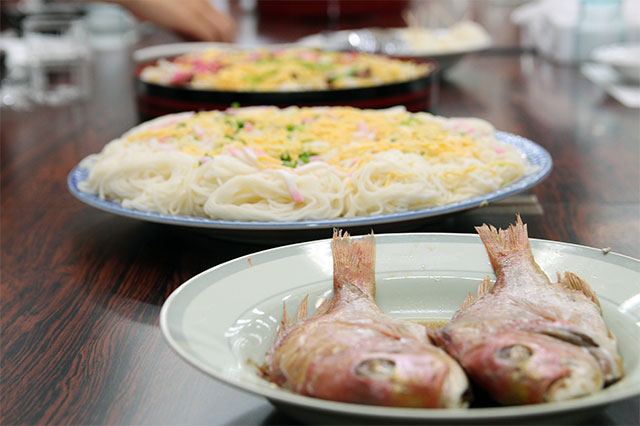
The Tokushima Prefecture-Yung-sama, which is eaten in Tokushima Prefecture-Chan, is not a common dish. Instead of boiling the fish, the bowl is served with boiling juice. We use the juice to sweeten and cook the citrus that we have caught on Hanashima. It's one of the ideas that can be enjoyed even by the rest of the soup.
When It Is Eaten
When holding festivals, weddings, or feasts, they are served along with the broth of soy sauce. It's an essential dish for celebration.
How It Is Eaten
I'll get rid of all the sieves and intestines and boil them with sugar and make the soup. It's the point to boil the rice and wash it, and then spread it on the bowl, to decorate it with the silky silky eggs, so on and on. It's delicious even if you add your favorite pepper.
Recipe — Serves 10
Ingredients
- 1 kg(10 bunches) somen noodles
- 10) 1 kg sea bream
- Mix: 800 ml water
- Mix: 80 ml sake
- Mix: 80 ml mirin
- Mix: 180 ml dark soy sauce
- Mix: 60 g ザラメ糖
- 3 egg
- 10 green onion
- 1 with a plate (kamaboko (fish cake))
- 20 g(1 cloves) ginger
Method
- I'll take the scales of renco and wash them off the entrails.
- All the flavor and water in the pot will boil with a fire of fire.
- When it's boiling, put in a rencos and boil it in the middle for 15 minutes.
- Take out the lencos and taste them and boil the soup for about five minutes with a weak cook.
- Cut three eggs apart and stir well. Hoting egg-burned fried pans, pulling salad oil, about one sixth of the fluid, cooking the sink so that it would spread thinly over the whole pan, and then turning it upside down. Repeat this, and cook the six-chilled eggs until the eggs are gone. When all is burned, the silky egg will be put on top of it and cut into pieces.
- I'll cut the pepper into strips and cut the onions into small slices. I'll leave the ginger on the table.
- The bowl is in the front of the bag. Wash the steamed peas in water, and wrap them around a small bowl with both hands and middle fingers. If you want to do it individually, you'll have about seven meals per plate.
- On top of the bowl, I will rub down the silky eggs, the eggs, the onions, and the onions, and add some to the side of the dish.
- The boiled fish will be on another plate. I'm going to put the tracker in another vessel.
More About Shimasōmen
Haneshima's native dish is Tokushima Prefecture, from the town of Kasai.
It is characteristic of the soup used in making the remkodi stew that was caught on Haneshima. It is thought that the dish was produced by a cook to use the fish in vain.
Remkodi stew is an essential dish for festivals, weddings, celebrations, and feasts, but it is served along with boiling.
It's not clear when the birth was born, but at the latest, it was eaten regularly before World War II. I'm going to put more noodles on top of them, and I'm going to put on lots of onions, macaroni, and silky eggs. The container with the soup in it is placed at the center of the plate with a citrus. Remkody's boiling is also served in another container.
It was identified as a 100-year hood every 2021 year.
Text adapted and translated from the Japanese Wikipedia article 島そうめん by its contributors, licensed CC BY-SA 4.0.
Dish data: Ministry of Agriculture, Forestry and Fisheries (MAFF), “Uchi no Kyodo Ryori” (Our Regional Cuisines) database, used under the Public Data License (PDL1.0); translated and adapted from the Japanese original.