Suiton ひっつみ
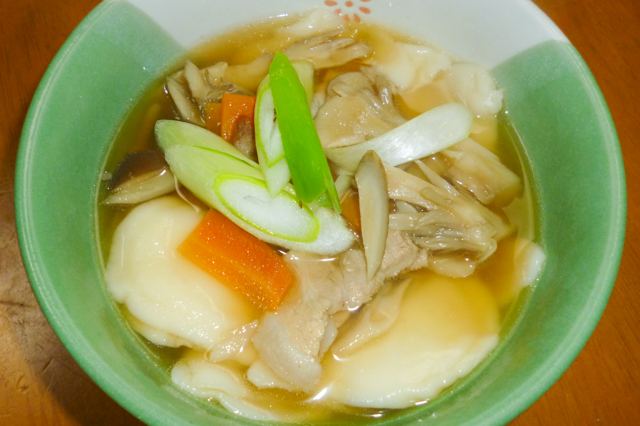
| Prefecture | Aomori (青森県) |
|---|---|
| Region | Tohoku |
| Japanese name | ひっつみ |
| Home area | Southern |
| Main ingredients | I've got wheat, chicken, carrots, and so on. |
History and Origins
In the southern part of the country, where the fields are spreading because it's cold and old and not ready for rice making, gravy, flour, and florida were introduced from old times. One theory is that from a peace age, there has been a "Trembling." They are known as the gravy of the meat of the rice-sized and unsuspected pottery. They are eaten easily, not only in postwar food troubles, but even in our time.
When It Is Eaten
In the southern part of the country, it is said that wheat has been produced from old times, that it has come to be called a "sniff." Materials and juices vary in variety from community to season and from family to household. In the coastal areas, crabs, fish, fish, and mountain regions use a lot of chicken and add a lot of seasonal vegetables. Even when cooking with the same powder, it doesn't have to be stretched out like a noodle. It's easy enough to pick up, so it's popular at home and it's long known.
How It Is Eaten
It's the trick of sifting flour and waiting for the dough to wear off, and this creates a unique sense of food. They say that in the past, they spent lunch vacations preparing meals for bed and dinner. It's best to eat with the materials and the juice when you rip the dough into a pot and float it up. If you have a large cut of crabs in a pot, and you boil them, and you boil them out, and you add a "sniff" in a bowl, it's a special bite in the coastal area.
Recipe
Ingredients
- 500 g wheat flour (bread flour)
- 2 cups water
- 200–250 g chicken
- 1 carrot
- 1 burdock root
- 3 green onion
- a pinch sake
- soy sauce, to taste
- 10 cups dashi stock
- ※その他
Method
- It takes only two cups of water to fill the flour and rub it a little softer than the ear.
- I'll have a wet frickin on me for an hour and a half.
- The chicken is cut to size. Carrots, I'll give you a kiss.
- It's in a pot and soup, chicken, carrots and rice, boiling it and eating it.
- Put the glue on your left hand, thin it with both fingers, rip it off, and place it in the boiling juice.
- Finally, I'll taste it with soy sauce and wine, and then I'll chop a piece of cut-and-stitch and stop the fire.
- If you do it well, you won't get a good cut. If you stay overnight, you get even better. When you're eating a bite, you should do it at lunch break, keep a bed, and cook at dinner.
More About Suiton
Suiton (水団 or すいとん) is a Japanese dish that is made by slicing flour dough by hand, rolling it by hand, and scooping it into small pieces, then boiling it in soup.
Overview
Suiton has a long history, and its root "mizu-dango" can be seen in the Muromachi period. It is also called "water dumpling". The cooking method of suiton on the material has changed drastically, and the form of hand-cooked flour like today appears in the late Edo period. From the Edo era to the prewar days, there were stalls and restaurants specializing in suiton, and it was popular food for ordinary people at that time. Although it had decreased considerably in the middle of the Taisho era, immediately after the Great Kanto Earthquake, stalls appeared everywhere in the burned fields as the food situation worsened.
It is a type of dumpling, and as a cooking recipe, "suiton" is made from crushing grains and nuts containing gluten and dropping them into hot water or soup. The way to eat depends on how much effort or arrange the cook has, or a regional custom.
There are many variations, such as simple dumplings made by mixed dough into hot water, and zoni with miso soup or simple soup with broth.
Suiton is also sold as vacuum-packed products by noodle manufacturers such as Shimadaya.
Regional Variation
The name of "suito" is known nationwide, but differs a little depending on the region, "hittsumi (ひっつみ)", "hatto" (はっと), "tsumeri" (つめり), "tottenage" (とってなげ), "odansu" (おだんす) and "hinnobe" (ひんのべ); - called by the name of the dish. These foods similar to suiton are characterized by the ingredients and dashi stock that are put in each region, and the cooking methods differ from region to region. Even in the same region, cooking methods and names vary depending on a district or individual home.
For example, "Hatto" in the northern area of the Miyagi prefecture to Iwate prefecture in the northern part of the Sendai clan is divided into small chunks of flour dough kneaded with cool water and thinned by stretching it like noodle with fingers. In Aomori prefecture, Iwate prefecture, etc., the manner of dividing flour dough is different.
Text adapted from the English Wikipedia article Suiton by its contributors, licensed CC BY-SA 4.0.
Dish data: Ministry of Agriculture, Forestry and Fisheries (MAFF), “Uchi no Kyodo Ryori” (Our Regional Cuisines) database, used under the Public Data License (PDL1.0); translated and adapted from the Japanese original.