Hoshimochi 干し餅
| Prefecture | Aomori (青森県) |
|---|---|
| Region | Tohoku |
| Japanese name | 干し餅(ほしもち) |
| Reading | Hoshimochi |
| Home area | Tsugaru |
| Main ingredients | rice, sugar. |
History and Origins
The survival diet of the cold and mild climates that have been created during the cold has been called "frozen." It's made in the Tsugaru area, but of all, Fukuokahara is famous. At one time, the freezing snows that were hung on houses and houses were the windy poetry of winter. We'll cut the cucumbers with more permafrost than usual, we'll weave them in long strips in strips, we'll dip them in water once a cold day, we'll hang them outside, we'll freeze them and then we'll make them wind-heated. It's a two-month-long and very difficult job. In the past, it was built by the whole region to fit into the annual event, and it would be delicious if it were made in about the coldest February of the year.
When It Is Eaten
Because of the good preservation and hunger and abundant energy sources, it was prized as a snack in the fields during the spring and summer season. I could eat it as it was, and because it was sweet on the side, the kids were also popular. The good dryer is easily broken by hand, and when you put it in your mouth, you have a unique sense of smell, which is very distinctive.
How It Is Eaten
In the past, each home had a "swallowing inquisition," and they measured the time and dried it while they watched the weather. Sometimes you can make a difference by putting in and color things such as rice, roasting beans, their leaves, pumpkins, nuts, reds, or old flowers. Besides eating it as it is, if you take it lightly, you can feel the sweets of rice. If you add roasted butter, buttery oil, or fried with oil, it will be delicious with a different taste.
Recipe
Ingredients
- 4.5 kg (3) glutinous rice
- 300 g sugar
- 20 g salt
- 1440 ml water
- ごま 小皿一杯
Method
- You can wash rice and soak it in water all day and all night.
- If you don't want rice, and cut enough water, put it in the rice and steam it.
- If it's steamed, I'll put it in the fan. Put salt and water on the way. The water can be divided into several pieces.
- After a good amount of cucumbers are added, the sugar is gradually poured into the sugar, and it gets even better.
- We spread plastics and rice in the nursery box. The surface is also covered with plastic.
- When it comes to the second day after this, I'll rip off the plastic and turn it upside down.
- On the third day, I cut off the broom. 10 centimeters times 6 centimeters.
- I'll look at the cold days at night and weave a cut-off bowl. I'll weave seven with a plastic string. I'll tie it to another one.
- After you have knitted the rice, put it in a box and put it in boiling water, which is 35 degrees. Try to touch it until it becomes soft. (about two hours without changing the water)
- I take the bowl out of the box, put it in the box, and I'm cool. If you take it out while it's still soft and cool, it'll be a hard spot. In the morning, the brooms are white. )
- To freeze again, on the evening of a cold day, ten bowls are soaked in water that looks like a 40- degree temperature and then dried again. Besides the fact that a lot of rice is added at a time, it's going to get very hot and it's going to get very hot. It's good to put it in a hard hot water one by one. If you stay in the hot water for too long, you'll be careful because it's too soft.
- We'll dry it out for at least a month and dry it thoroughly.
- It's perfect where there's a little wind, but if the wind is too strong, the bumps will break. The drought begins to grow in the cold.
More About Hoshimochi
The dried rice is traditionally preserved food that has contained a lot of water in the bush and frozen it, and then exposed to cold. In some localities, there are various names, such as "frozen" and "frozen ice."
Overview
Drowning is made by using winter cold waves to freeze the cucumbers. (The diet of such frozen cinders is seen from the Tohoku region to the sub-permeable, and the product of the Tohoku region is mainly called "Scrolling" in the area of Tsukoku, called "Founding").) They used to eat at the time and at the time of the day. Now, it's commonly recognized as a local treat, and it's sold by hand for reproduction and so forth.
Characteristics
It's better to have a good tooth, sweetness, and save to summertime than normal, so that it can dry up and dry for longer periods. It's a hard impression on the eye, but when it's pressed on the finger, it's so fragile that it's used as an ingredient for Japanese sweets.
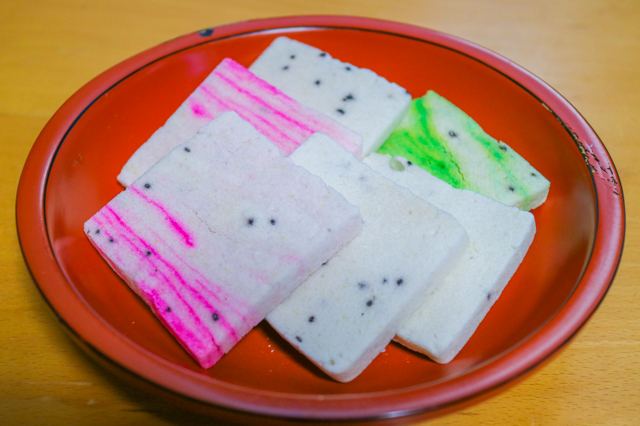
In some places, they are made by mixing all kinds of ingredients with a mixture of cow's or lamb's or soup's or soy, and many are colored using vegetable colors.
The Process
The rice is steamed enough and made firm. I'll put it in a mold and cool it. Cut cold, solid objects into easy-to-eat size. It contains water that shapes a few pieces of straw in a shape that is easy to hang. I'll freeze it for about a month. It's best when it's cold and dry. (CLEARSSING)
How to Eat
There are other ways of eating, such as using stoves and stoves, in addition to being able to eat as much as you can eat as you can, in the water and eat as much as you normally do in the oven. Also sold are products that have been seasoned with sugar, salt, and so on for oiled dryers.
Text adapted and translated from the Japanese Wikipedia article 干し餅 by its contributors, licensed CC BY-SA 4.0.
Dish data: Ministry of Agriculture, Forestry and Fisheries (MAFF), “Uchi no Kyodo Ryori” (Our Regional Cuisines) database, used under the Public Data License (PDL1.0); translated and adapted from the Japanese original.